Thursday, October 28, 2010

A Chimp Off the Old Block


Question: Do infants have a connection to their mother because of survival or is there a deeper connection?

Hypothesis: Scientists believed that infants felt an attraction to their mothers for food and shelter, and that the mother showing affection towards her child was merely a sentimental gesture that served no real purpose.

Study Type: The study is a laboratory type study because scientists replicated the monkey’s natural environment in a laboratory to study them.

Ethical Issues: Ethical issues arose from the scientists separating baby monkeys from their mothers, isolating them from contact and occasionally putting them under stress. Further issues surrounded the crippling of the emotional development of the monkeys.

In University of Wisconsin laboratory, Harry Harlow took several infant monkeys of a few weeks old from their mothers and put them in individual cages. On one side of the cage, there was a wire replica of a mother monkey that suspended a milk bottle. On the other side of the cage, there was a softer cloth replica of a mother monkey that did not offer any food. The scientists observed the monkeys in their cages, noting specifically that the monkeys would prefer to stay near the cloth replica, despite the fact that it offered no nourishment. They would use the cloth mother as a “home base”, centering the explorations of their cages around it.

Following that, Harlow put the monkeys in new cages – this time, half of the monkeys only had a cloth mother and half of the monkeys had the wire duplicates. He then subjected the monkeys to stress through loud noises and drastic changes in the lighting. He noted that the monkeys with the cloth mothers would run to them, and lay on them in order to calm themselves from the stress. The monkeys with the wire mothers, however, would simply scream and run around their cages, as if the wire mother offered no comfort.

Authors: Sami Shroyer and Sam Peltier

Tuesday, October 26, 2010

Dissociative Identity Disorder


Dissociative Identity Disorder is a disorder previously known as Multiple Personality Disorder. Many people believe it be similar to schizophrenia, however, the two are very different. DID is when a person develops two or more “personalities” as a way of coping with severe trauma. The different personalities often do not know of the others existence which causes confusion for the original personality. DID sufferers very rarely only have two personalities. In fact, there have been cases of people having upwards of 15 personalities. Psychologists have known about DID for at least a century, and Sigmund Freud was one of the first psychologists to link the disease to trauma. DID usually occurs in patients who have experienced severe psychological trauma, the other personalities develop as a coping mechanism for the main personality.

Arguably the most famous case of DID was that of Shirley Ardell Mason, better known as Sybil. Mason developed 16 personalities ranging from adult women to a baby. Her case is well documented in the book and move Sybil. It is believed that Mason developed DID after suffering repeated sexual abuse at the hands of her mother when she was a small child. Her mother is also believed to be schizophrenic. Though many people with DID do have a family history of mental health problems, the disease is not hereditary. Rather, like substance abuse, if there is a family history of it the chances of developing it increase.

Author: Alyson Croney

The Theory of Psychological Repression


Repression, which Sigmund Freud also called “Motivated Forgetting”, is the inability to recall a threatening situation, person or event as a defense mechanism. The concept of Repression, now accepted as fact by psychologists was theorized by Sigmund Freud, an early pioneer in modern psychology, about how humans develop their personalities. According to Freud’s theory, in the Primary Repression phase, an infant learns that some aspects of reality are pleasant, and others are unpleasant; that some are controllable, and others not. In order to define the "self", the infant must repress the natural assumption that all things are equal. At the end of this phase, the child can now distinguish between desires, fears, self, and others.

The secondary stage of Repression begins once the child realizes that acting on some desires may bring anxiety. This anxiety leads to repression of the desire. The threat of punishment related to this form of anxiety, when internalized becomes the “superego”, which intercedes against the desires of the “id” without the need for any identifiable external threat. This conflict then manifests itself within the “ego”.

Elizabeth Loftus tried to use this theory to implant false memories in individuals in the late 20th century. However she could not complete her experiment because it was seen as unethical to implant someone with painful thoughts or memories. There’s an enormous amount of supporting research in the area of this subject started in the 1950s by Leon Festinger and other researchers.

Another way of understanding this is much simpler: a repressed, traumatic event arouses anxiety of the event without arousing the memory.

Author: Lucas Pscheidt

Lying in the Brain


Some liars are not just lying because they are trying to prevent a conflict. To a pathological liar it is actually easer to lie than telling the truth. Pathological liars usually lie without thinking about it. Their lying is so subconscious that most pathological liars never correct this mental disorder.

A study was done in 2005 by neuroscientists Adrian Raine and Yaling Yang. These two scientists took 21 normal people that did not have a history of pathological lying, 16 people with antisocial personalities, and 12 people with a history of pathological lying. All of these 29 test subjects brain’s where scanned and examined by a MRI. Adian and Yaling found that the pathological liars had more white matter and less gray matter in the prefrontal cortex of their brains than the rest of the test subjects; the normal test subjects had more gray matter and less white matter than the rest of the test subjects. They also found that pathological liars have about 26% more white matter in their prefrontal cortex than most people with other mental disorder.

Although there is no cure for a pathological liar, medication and therapy helps reduce the frequency of lies for some of them. Yet some times these techniques do not work due to the patient lying about taking their medications or lying in their therapy sessions.

Author: Nick Pederson

Peter Pan Syndrome


Peter Pan syndrome, also known as puer aeternus meaning eternal boy in Latin, is a psychological condition where an older man cannot grow up emotionally and mentally. This syndrome is caused by a desire to remain young and not face the responsibilities of his adulthood. This syndrome is usually coupled with great dependence on the mother. Peter Pan syndrome is usually caused by the rejection from the adult world. As a defense, the person hides from the adult world. A fear of failure and insecurity lead him to rely more on his mother who is an ultimate provider of care, love, and confidence. As a result, person with Peter Pan syndrome tends to be rebellious towards the social orders and rules.

Specific Symptoms
• Find it hard to show their love and express their feelings
• Lose touch with their emotions and have no idea what they feel
• Procrastinate and put off making a commitment
• Feel guilty and blame others for everything
• Have difficulty in relaxing and are always tense
• Have no real connection with friends. Believes friends can only be bought
• Easily panics and feels desperately alone in their attempts to belong
• Alcohol or drug abuse is used to get high in order to drown out the existence of daily life challenges
• Have a problem with their mother
• Don't get on with the Dad and probably not even talking to them
• They believe their parents don't love them and never approve of what they do
• Have problems with authority figures
• Tend to be emotionally immature and exhibit silly behavior
• Have a macho attitude that hides their deep inner insecurities in attempts to hide the fear of rejection
• Become extremely jealous and exhibit violent outbursts
• Become easily provoked to fits of rage when a woman asserts any independence

The term Peter Pan syndrome was coined by pop psychologist Dan Kiley in his book “Peter Pan syndrome: Men who Have Never Grown Up.” Peter Pan is in reference to J.M. Barrie’s classic play Peter Pan where a boy refuses to grow up.

Author: Gabe Choi

Friday, October 22, 2010

Depersonalization Disorder


Depersonalization disorder is a psychological ailment that gives sufferers a sense of detachment from one’s self or a sense of automation. To people with this disorder, they feel like they are in a dream or like they are going through life without really experiencing it. Individuals with this disorder also describe that they have experiences where they are not in control of their thoughts, emotions, or even their own actions and they feel like someone else is in control.

This disorder is fascinating as it acts as a defense mechanism for the sufferer. People who have gone through deep psychological trauma such as childhood sexual, physical, and emotional abuse; accidents, war, and torture. People with this disorder slip into periods of unreality where their subconscious takes over. This is to protect them from reoccurring thoughts of past traumatic events that are usually brought on by stress.

To this day, there is still no official cure or treatment for depersonalization disorder. A variety of psychotherapeutic techniques have been applied yet the disorder has remained resistant to any and all treatments. Treatments, however, are in the process of being researched.

Author: Spencer Franklin

Lucid Dreaming

Lucid dreaming is a dream in which one is aware that they are dreaming and in retrospect can control their dream. There are two ways one can have a lucid dream, either a Dream-initiated lucid dream (DILD) or a Wake-initiated lucid dream (WILD). A DILD occurs when one is in the state of dreaming, and consciously realizes that they are in a dream. A WILD happens when the dreamer goes from a waking state directly into a dreaming state; with no lapse of consciousness.

Lucid dreaming is interesting because very few people can actually do it. However it can be attained by external cues in a kind of classical conditioning. For example a study was done in the early 1970’s at South Dakota University, where the subject listened to a tape before and during sleep. They would use a muffed bell alarm, and bright light whenever the subject reached REM sleep; to try and provoke the lucid dreaming. It turned out that lucid dreaming can be provoked using external cues and psychological methods. Philosopher Norman Malcolm argued against the possibility of checking dream reports; saying the realization of the dreamer’s eyes affected their physical eyes. Proving that actions used while in full consciousness could be repeated in a lucid dream. Parapsychologist Keith Hearne proved this in the late 1970’s by testing a trained lucid dreamer Alan Worsley, who used rapid eye movements to contact that he was one the onset of lucidity; it was recorded by a Polysomnograph machine.


Author: Kyle Fagan

Schizophrenia


Schizophrenia is a psychological disorder (or grouping of psychological disorders) where a person looses touch with reality. It is a chronic and debilitating disorder meaning “split mind” in Greek. This disorder is shown through the patient’s impaired reasoning, violent behavior, and emotional instability. Also, hearing voices, having hallucinations, and delusions are common. Many with schizophrenia are convinced people like the FBI, God, or aliens are telling them to act in certain ways. Being unable to complete thoughts or ideas is another symptom of schizophrenia. People who are schizophrenic cannot decipher signals from the outside world and see objects for things very different than what they are. There are many different symptoms shown by schizophrenics.

Untreated, people who have schizophrenia will slowly leave the normal world and enter into their own reality. There is medication to treat these patients, but sometimes hospitalization or psychotherapy is needed. Schizophrenia is argued by many psychologists to be caused by hereditary reasons, chemical imbalance, or viral infection. It is usually diagnosed between the ages 17-35 and approximately affects 1% of the population. There are no tests to take to see if one is schizophrenic, but by observing a patient doctors can diagnose this after ruling out all other options.

Schizophrenia is an interesting disorder because it is experienced by everyone differently. Although some symptoms are shared all, each patient has his/her own story. While we now with modern science and technology can understand how some disorders work, we cannot understand how people with Schizophrenia view the world. Since every patient has different symptoms we could never get a broader view on how exactly it feels to have this disorder.

Author: Olivia Hawkinson

Tuesday, October 19, 2010

Taken


Imagine yourself in a hostage situation: You're at the bank to deposit a pair of checks and the next thing you know the bank is being robbed. This is no common robbery, rather, it's a six day long takeover where you and many others are taken hostage. Interestingly, instead of rebelling against your captors as one might expect, you begin to support their cause, believe in their motive, and, in extreme cases, resist rescue. This is no fantasy. In 1973, in Stockholm, Sweden, such an event occurred. This change in behavior seen in hostages--from hostile to friendly--is known as Stockholm Syndrome.

Since the seminal event in 1973, other famous cases are often cited that illustrate Stockholm Syndrome. In one, a wealthy heiress and college student named Patty Hearst was kidnapped and held hostage by the Symbionese Liberation Army in 1974. Rather than resist and escape, Hearst eventually joined the groups efforts in robbing banks, organizing members, and promoting the group's cause. Not until after she was removed from their presence did Hearst denounce these activities.

Stockholm Syndrome also rears its head in cases of domestic abuse, both physical and emotional, where the abused person feels it is not right to turn in the abuser. Often identified as a defense mechanism, Stockholm Syndrome explains what appears as irrational behavior. While it seems logical to remove yourself from captors and abusers, psychologists have found that the mind makes sense of these events in strangely powerful ways.

Pictured: Patty Hearst in a Symbionese Liberation Army publicity photoraph

Author: Zachary Lauritzen

Wednesday, October 6, 2010

An Operant Opportunity


Question: Can an animal’s behavior be shaped
through the implementation of reinforcement?

Hypothesis
: An animal’s behavior can be shaped by applying reinforcement.

Ethical Issues/ Concerns: The pigeons involved in the studies were starved and subjected to below average living conditions in order to increase the effectiveness of using food as positive reinforcement.

Description of Study: Skinner has conducted multiple studies concerning his posed question which he has termed as operant conditioning. Many of his more notable experiments involved pigeons. In these experiments, a pigeon was trained to perform an action by being positively reinforced with food. One of his initial experiments involved a solitary penguin facing a wall with a slot that opened and closed to reveal food. Skinner eventually conditioned the pigeon to turn counter-clockwise in order to receive food. He did this by providing the pigeon with food when it started to turn in the right direction. Eventually the pigeon learned that the food was controlled by its counter-clockwise movement. One of Skinner’s more advanced operant conditioning experiments is pictured above. Here Skinner successfully trained two pigeons to play ping pong with their beaks. He succeeded by giving them food every time they knocked the ball past the other pigeon. As time progressed, the pigeons developed techniques for winning such as producing angled shots. Through multiple experiments such as these, Skinner successfully developed the concept of operant conditioning.

Authors: Matthew Boggess and Christian Meunier

Tuesday, October 5, 2010

Loftus and Palmer 1974


Question: How language, mainly asking an individual about an event, can affect the memory of a witness.

Hypothesis: The hypothesis of this experiment was that memory is not an accurate recording of an event and that memories can become distorted by other information which occurs after the event.

Study Type: Laboratory Observation

Ethical Issues/Problems: There weren’t any ethical issues when performing this experiment.

Description: The main focus of this experiment was to observe how information supplied after an event, affects a witness’s memory of the event. In order to do this, E.F. Loftus and J.C. Palmer set up two different experiments. The first one included a group of 45 students from the University of Washington. These students were shown various clips that had to do with safety and traffic accidents. After watching the clips, the students were asked to respond to what they observed. They were also given specific questions and one critical question asking about the vehicles’ speeds in the collision. This question was ‘About how fast were the cars going when they *** each other?’ For each of these conditions, a different word was used in the space, such as crashed, smashed, and collided. After reviewing the answers, Loftus and Palmer concluded that the phrasing of the question created a difference in speed estimate. They could then conclude that the memory of how fast the cars were traveling could have been altered by the verbal label that was used to describe the crash. In the second experiment, they wanted to back up the theory that the speed estimate was affected by the verbal label. This time, 150 students participated and watched a 1 minute clip which contained a 4 second scene of a multiple car accident. 50 participants were then asked 'How fast were the cars going when they hit each other?’ Another group of 50 participants were asked 'How fast were the cars going when they smashed into each other?' The remaining 50 of the participants were not questioned about the speed of the vehicles. After a week later, the participants were asked a critical question asking whether there was broken glass at the scene or not. The results were that a significant amount of people were more likely to remember seeing broken glass when they heard the word ‘smashed.’

Author: Tessa Hockley

Do You Need the Cop?


What: Kansas City Preventive Patrol Experiment

Where: Kansas City, Missouri

When: October, 1972-1973

Question: Do Police patrols have an impact on the crime rates and the public’s feeling of safety from crimes.

Hypothesis: If Police patrols are lowered, then crime rates would increase. If Police patrols are increased, then crime rates would increase.

Research Methods: Three separate areas in the city. One area would receive no patrols. The only police presence would come in answering calls. The second area would receive an increase in police presence by two times what would be normal. The last area would receive the normal amount of police patrols.

Ethical Issues: Citizens in one area would receive no patrols. Leaving the citizens without any police presence could be dangerous to society and would be unethical to leave the citizens unprotected.

Type of Study: This experiment was focusing on one police department over a long period of time. Therefore, this experiment is a longitudinal case study.

Description and Results: The Kansas City Police Department, in 1973, wanted to find out if the presence of police patrols had any impact on crime rates and public’s feeling of safety. Over the course of one year, the police department began to vary its patrol presence in different parts of Kansas City. At the end of the experiment, data was collected based on items public surveys and police reports. The results showed no significant change in crime rates and the public’s feeling of safety in any of the three areas.

Impact: This information should not cause people to say we should remove all patrols. That type of action would be foolish and the taxpaying public would not approve. What can be said, however, is that officers on patrol may be able to perform personal related tasks while there is some free time during patrols.

Author: Evan Barnes

22 Boys


Question: Will two different groups that hate each other come together for common goal?

Hypothesis: If two groups hate each other then have a common goal they will form roles for every one, work as a team.

Study Type: participate

Issues and problems: Taking 22 boys pinning them against each other. Having 11 year old boys participate.

Description: Mauzafer and Carolyn Sherif took 22 boys and split them up into two teams, the teams did know of each other at Robbers Cave Park in Oklahoma. The boys were 11 years old. One day they met and started to play games against each other. The scientists were the camp counselor. They all started to make fun of each other, and lots of name calling. So after the competition the scientists gave them the option of watching a movie but they had to pay for it. The boys all agreed to split it equally. One of the teams paid for milk shakes for all the boys since they won the competition and got five dollars. Yet everyone else paid for they own food. The boys all wanted to ride the same bus. They worked together for a movie and milk shakes even though they hated each other.

Author: Molly Lomax

Rosenzweig's Rats


Question: How do early experiences effect future growth and development of the brain?

Hypothesis: An enriched environment in early childhood can lead to increased brain growth.

Study Type: Laboratory Observation

Ethical Issues and Problems: The rats could have experienced different levels of brain activity prior to the experiment, which could cause conflicting results in the data. Because the rats aren’t in their natural environment, results wouldn’t reflect their natural patterns. Issues could arise when relating the data to humans because of differences in brain development and reaction to procedures.

Description of Study: In the 1960’s Mark Rosenzweig conducted an experiment with two other scientists to prove that neurological development continues into adulthood. Rosenzweig and his associates kept rats in two different environments: one stark and solitary, the other enriched with toys and playmates. Rosenzweig analyzed the brains of the rats upon their death, and discovered that the rats living in the enriched environment had an increase in brain weight of 7-10%, a few even reaching 20%. Another doctor later joined the team to prove that these effects would occur even in adulthood. The studies were successful, and later repeated on other species. The results proved that adults have the same potential for brain growth as do juveniles.

Authors: Carly Uebel & Cathy Hamby

"We're All Mad Here": Rosenhan in Wonderland


Question: If sanity and insanity exist, how shall we know them?

Hypothesis: Do the salient characteristics that lead to diagnoses reside in the patients themselves or in the environment and context in which observers find them?

Study: Participant Observation

Design: David Rosenhan and 7 associates mimicked the characteristics of schizophrenia in order to gain entry into several mental hospitals on the East and West coasts to observe the staff’s diagnosis, or the assumptions, on the behavior of the legitimate patients and the pseudopatients. Once the subjects gained entry into a sanatorium, they ceased all psychotic characteristics and began to act as they would on a normal basis to see if the staff would be able to recognize the person’s sanity.

Description: Rosenhan’s study concluded that the environment and context of a person’s questionable sanity plays a huge role in the perception of the observer (i.e. the Psychologist and Mental Hospital staff). The participants in this study never had their sanity questioned by a staff member even though they exhibited no symptoms of mental illness after induction; however, several of the legitimate mental patients were able to distinguish the falsified patients from the mentally ill.
Rosenhan also discovered that normal undisturbed human actions or behavior such as boredom were misconstrued as anxiety or other emotional or mental disruptions. Judging by the way that the hospitals psychologist would interpret the pseudopatients normal past (with no instance of mental illness or any plausible event that would cause any mental abnormality) into an out of proportion turbulent life that would trigger dormant schizophrenia, it was shown that by the observer having the preconceived (and falsified) notions of the individual, the observer would try to find reasons that would justify the pseudopatients supposed schizophrenia. The hospital staffs were self fulfilling their prophecies or conceptions concerning the pseudopatients because of the information they were fed and truly believed.

Author: Carly Malm

The Bargaining Table


Question: Is forced or cooperative communication most successful in bargaining?

Hypothesis: Since a hypothesis was not explicitly stated, it is assumed that Deutsch and Kraus expected a bilateral threat to be most effective for short-term bargaining.

Study type: Testing

Ethical issues/problems: Since this was just a game, no ethical issues or problems arose. Deutsch and Kraus generally worked only with game theory, resulting in safe studies for all parties involved.

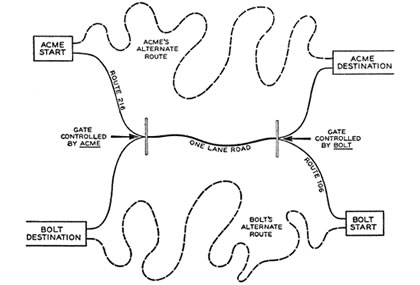
Description of study: Two people are selected at random to play a trucking game simulation against each other. The people are places in separate cubicles and are not allowed to have any direct communication during the game. One person is the Acme Truck Company and the other is Bolt Truck Company; each player must get from the start point to their respective destinations as quickly as possible, as quick transit translates into more profit. Players each control one gate, or threat, that is necessary for the opponent to pass through if he/she wants to go down the most efficient route. Deutsch and Kraus found that simulations that left both gates closed, meaning that bilateral threats were used, were least successful in gaining profit. The most successful simulations were those that had both gates open, representing bilateral cooperation.

Author: Hannah Kendrick

Hastorf and Cantril "They Saw a Game"


Question: How does your group affiliation affect your memory/opinion?

Hypothesis: They probably hypothesized that the subjects from one school would accuse the opposing players of starting the scuffle.

Type of Research Method: Case Study/Testing; Survey after showing them the video of the fight

Ethical Issues Involved: There were no ethical issues.

Basic Understanding: This is really confusing because the information we found was contradicting and the following is our rough estimation.
Princeton and Dartmouth played an emotional football game which ended in violent foul play. Three years later Hastorf and Cantril conducted a study where they had the students watch the game film. After the film the subjects were given a survey asking students from each school “who started the foul play?” The results supported the hypothesis strongly.

Authors: Davis Kline and Erika Linden

Come to Your Senses, Don't Believe False Consensus


Question: Was there false consensus among college students?

Hypothesis: Ross, Green, and House believed that if the college students carried the sign, then they would think that the majority of people around them would also carry the sign because they believe that most people also think like them. This is same for the people who did not carry the sign.

Study Type: Testing

Ethical Issues and Problems: There were no ethical issues with this experiment, but there could be some problems. There could be a wide range of answers depending on who is asked, how intelligent the people are, the difference in age, and the difference in gender. It depends on how the people were sampled, and also if the people who were asked went with their gut feeling on the question or if they actually took the time to think about their answer.

Description of Study: Ross, Green, and House sampled college student on a campus. They asked students to wear a sign around campus saying ‘Eat at Joe’s’. They then asked the students if they thought that all the other students would also wear the sign. The students who agree to wear the sign believed that 62% of other students would also wear the sign (the majority). The people who disagreed to wear the sign, however, believed that 67% of people would not wear the sign (also the majority). Of course, the majority can not believe both, thus proving that false consensus was apparent at their campus.

Authors: Lauren Wickwire and Lauren Allen

The Importance of Mother Love


Question: How does the interaction of mother and child affect the development of the infant?

Hypothesis: The monkeys with a more realistic version of a mother develop a more normal behavior, because they have an emotional attachment.

Study Type:
The Rhesus Monkey experiment was a laboratory observation, because it was a made up setting and it was done in a laboratory, not in the natural environment.

Ethical Issues:
The experiment brought a lot of problems to the monkeys involved, for example they suffered of anorexia after being separated from the mothers, they also suffered because of the separation anxiety. Some of the monkeys even died.

Harry Harlow separated infant monkeys from their mothers short after the birth. He isolated them from the outside world. After a few weeks he gave the monkeys a choice between two fake mothers, one made of wire with a bottle of milk attached, the other mother was made out of smooth cloth but without any food. Harlow observed that the infant would go to the wire mum to drink but develop an attachment to the smooth warmed cloth mum. When the monkeys were scared they ran to their cloth mother to feel secure. But when only the wire mother or no mother was with them, the infants started to run around screaming. Harlow also realized that the monkeys raised with just a wire mum had serious problems digesting the milk and they lost weight. This experiment shows that the most important thing about the mother-child bond is the body contact to develop a feeling of security. When the monkeys got older they were separated for three days from their cloth mum. When they were reunited the monkey clung to their mother and didn’t let go to explore like it had done before the separation. Harlow’s explanation for that was that the need for contact comfort was stronger than the need to explore.

Authors: Javiera Wood and Lucia Schroth

Bystander Effect: What Would You Do?


Question: What will happen if more people are watching a traumatic event?

Hypothesis: The more people are watching something take place, the less likely they are to take action.

Study type:
This is an example of Naturalistic Observation.

Ethical issues and problems: A Good Samaritan in a large group might take action and lead others to follow suit therefore changing the results of the experiment.

Description of study: In order to test the Bystander Effect scientists John Darley and Bibb Litane staged several emergency situations and studied how long it took for one or more people to act, or not act. They found that when there are more people in the room observing the situation, it takes longer for people to act or not act because they think that they do not need their help. If the bystander is the only one witnessing the scene they are more likely to help the victim. One specific example occurred when participants were asked to fill out a questionnaire. The number of people in the room varied. As the participants filled out the questionnaire smoke began to fill the room. More people reported the smoke if they were taking the test alone.

Author:
Brittany Shreeve

Friday, October 1, 2010

Skinner's Box of Shocks


Question: Can any animal be trained to do a specific action when reinforced properly?
Hypothesis: An animal can be trained to perform specific actions when reinforced.
Type of Experiment: This experiment was a laboratory experiment.
Ethical Issues and Concerns: The ethical problems regarding this experiment are mostly pertaining to the treatment of the rat. Electrocuting the rat is painful to the animal, and therefore is unethical and cruel.
Description of Study: BF Skinner placed a starving rat into a box (picture shown). He first attempted to positively reinforce the rat. When the rat would push down on a lever, a pellet would be dispensed from the dispenser. This trained the rat to push the lever when it needed food. Later, Skinner attempted negative reinforcement, and placed an electrified grid underneath the rat. This electrocuted the rat constantly until the rat pushed down on the lever. In this way the rat learned to perform an action in order to stop the pain. This is one of Skinner’s most famous studies regarding operant conditioning.

Name of Author: Sammi Fisher