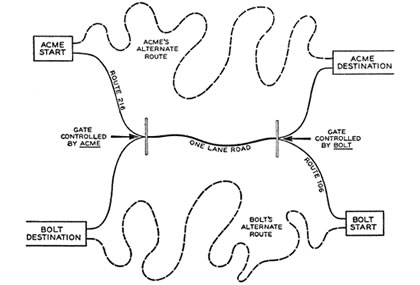
Question: Is forced or cooperative communication most successful in bargaining?
Hypothesis: Since a hypothesis was not explicitly stated, it is assumed that Deutsch and Kraus expected a bilateral threat to be most effective for short-term bargaining.
Study type: Testing
Ethical issues/problems: Since this was just a game, no ethical issues or problems arose. Deutsch and Kraus generally worked only with game theory, resulting in safe studies for all parties involved.
Description of study: Two people are selected at random to play a trucking game simulation against each other. The people are places in separate cubicles and are not allowed to have any direct communication during the game. One person is the Acme Truck Company and the other is Bolt Truck Company; each player must get from the start point to their respective destinations as quickly as possible, as quick transit translates into more profit. Players each control one gate, or threat, that is necessary for the opponent to pass through if he/she wants to go down the most efficient route. Deutsch and Kraus found that simulations that left both gates closed, meaning that bilateral threats were used, were least successful in gaining profit. The most successful simulations were those that had both gates open, representing bilateral cooperation.
Author: Hannah Kendrick

No comments:
Post a Comment